
Updated: November 2026
Surveys of retailers, executives and shoppers now give a measurable picture of AI product photography. Adoption is rising, shoppers report lower confidence when they learn an image is AI-generated, and regulators in the EU and New York have set disclosure and consent rules.
This page collects every primary-sourced number we could verify on that question. Each statistic links to the entity that produced it, with the date of the data. Where only a regional or narrow figure exists, we say so instead of presenting it as a global rate.
It is written for heads of ecommerce, creative directors and studio managers deciding how much of their image pipeline to give to AI. The figures cover market size, adoption, shopper trust, EU and New York rules, and the creative workforce, and each section says what its data does and does not show.
Market-size figures for AI image generation differ by an order of magnitude depending on who is counting and what they count. Treat every number below as one firm's definition, not a fact about the industry.
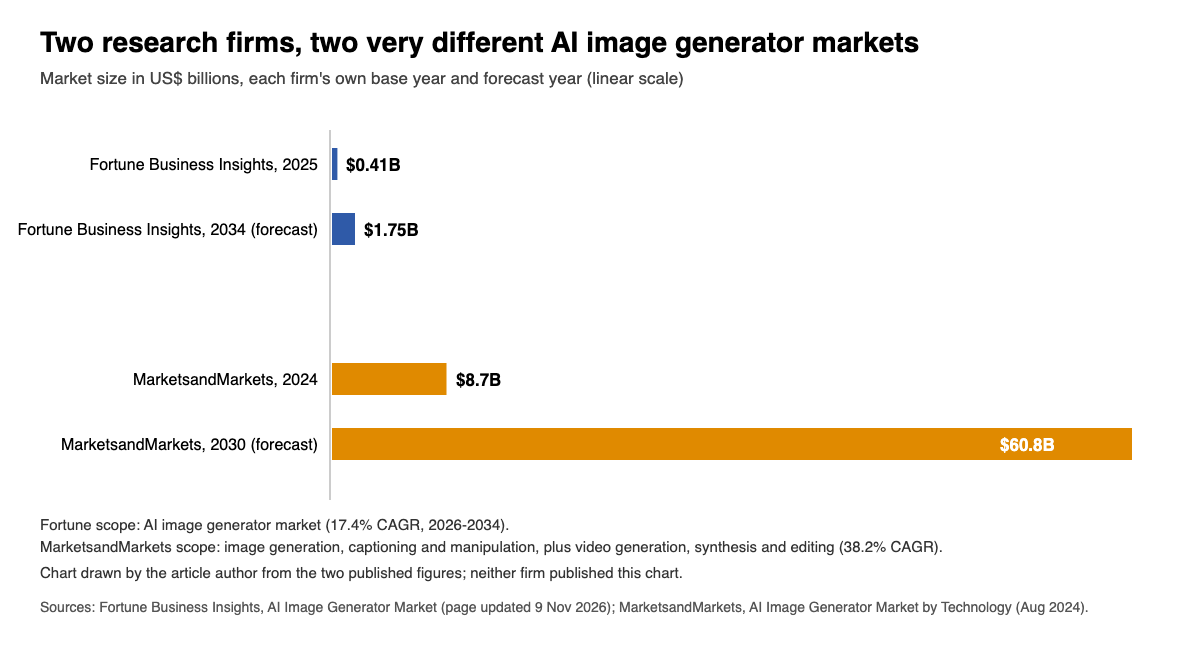
Figure 1: Two research firms size the AI image generator market an order of magnitude apart because they define it differently, so neither number can stand in for the other. Source: Fortune Business Insights, AI Image Generator Market, Nov 2026, and MarketsandMarkets, AI Image Generator Market by Technology, Aug 2024. Chart drawn by the author from the two published figures, because neither firm's own chart could be captured, on 26 Nov 2026.
Fortune sizes the narrowest version of the market: AI image generators.
MarketsandMarkets counts a much wider market, covering image generation, captioning and manipulation plus video generation, synthesis and editing (report page), and it published its forecast more than two years ago.
The gap comes mainly from scope, not from disagreement about demand. For a brand budgeting its own image pipeline, adoption data is a better guide than either market forecast, and the next section turns to it.
No survey gives a clean global answer, and anyone quoting one is guessing. What exists is a fashion-executive survey, a retailer survey that tracks image use year on year, and one very large retailer's own account of what it changed.
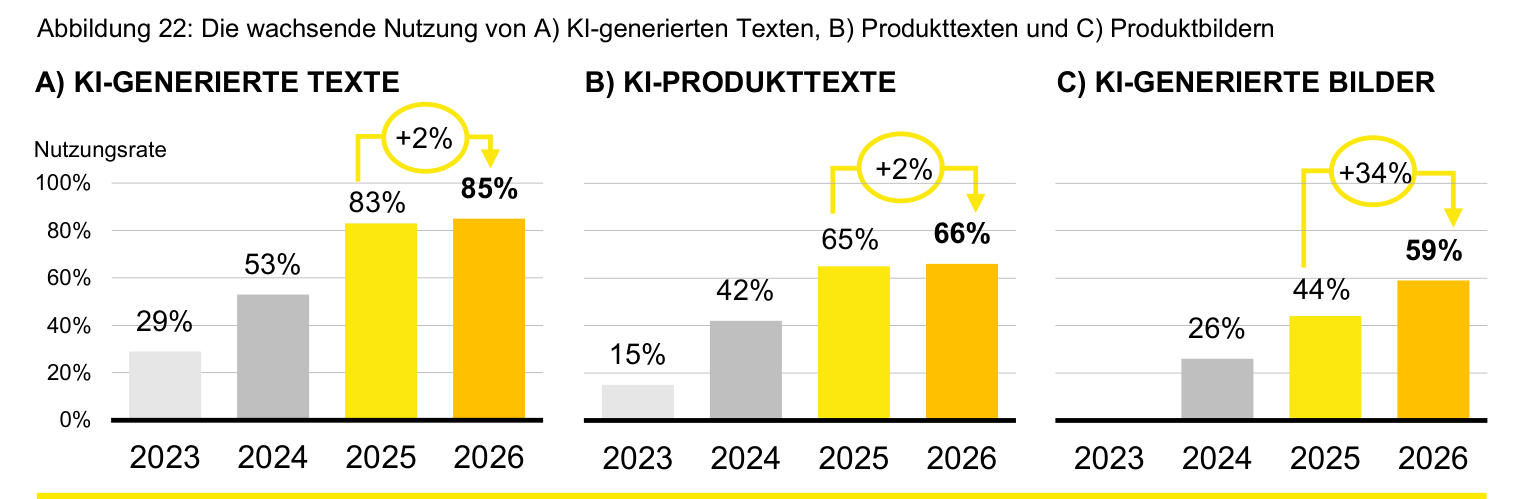
Figure 2: AI image generation is the content type still climbing fast among surveyed online retailers, while AI text use has levelled off. The +34% and +2% labels on the chart show relative growth in each share compared with the previous year, not percentage-point gains. Source: FHNW, Onlinehändlerbefragung 2026, Abbildung 22, Sep 2026 (survey fielded April to July 2026). Chart published by the source (panel C shows product images), cropped from page 66 and captured 26 Nov 2026.
The best fashion-wide survey measures generative AI broadly, not product imagery on its own. BoF and McKinsey list image creation among five example areas where executives report using it, alongside online customer service, copywriting, consumer search and product discovery (State of Fashion 2026). The report page gives no imagery-only share, so the headline figure in the Key Takeaways shows how common generative AI is across fashion, not how common AI product photography is.
More than half of surveyed retailers now do, and the climb has been steep.
The 2026 survey ran from 15 April to 31 July 2026, and about 90% of respondents are Swiss (FHNW survey). Read this as an indicator for European online retail, not a global adoption rate.
Zalando is the clearest primary example we found of a large retailer putting numbers on AI content in its own results.
Zalando's content team says the AI-generated share covers on-site marketing content, not product detail pages or advertising off the site, and that hero campaigns remain human-led (Zalando interview). Neither document reports a cost saving, so this page does not state one.
In the surveys below, shoppers say that learning an image is AI-generated would lower their confidence in buying, and consumers say they want to be told. These are stated attitudes, not measured purchasing behaviour, and the one behavioural test found is small and unreviewed.
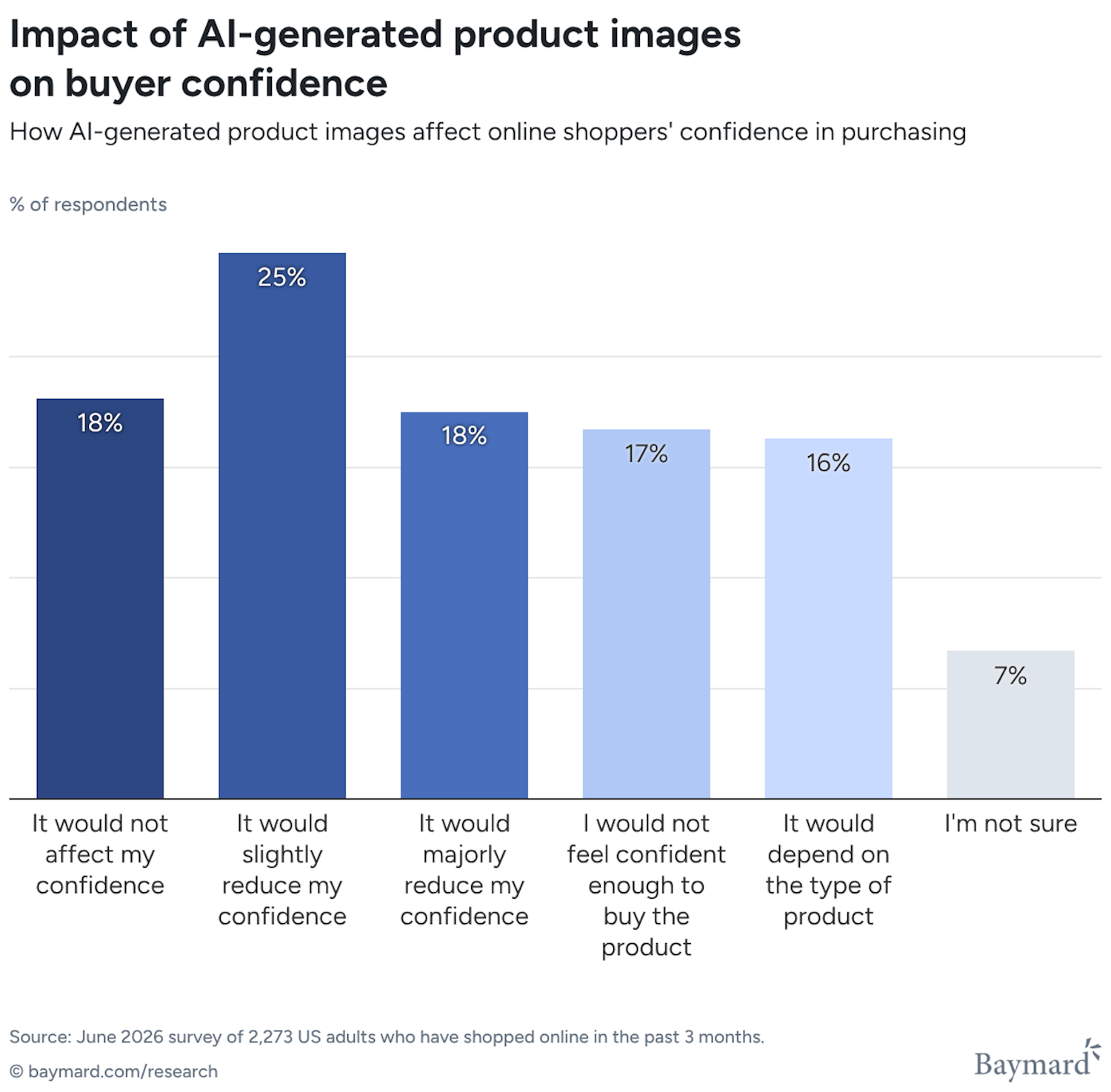
Figure 3: Most US shoppers say knowing an image is AI-generated would reduce their confidence to buy, and only a minority say it would make no difference. Source: Baymard Institute, AI Engagement quantitative study, Jun 2026 (survey of 2,273 US adults who shopped online in the past 3 months; published October 2026). Chart published by the source, captured 26 Nov 2026.
For most shoppers it reduces confidence, and a sizeable group would walk away.
Skepticism is broad, and it extends well beyond images.
Yes, and they link authenticity to trust.
Getty's research covered 25 countries with 7,500 respondents per survey, fielded from July 2022 to September 2023. Getty sells stock imagery, which gives it a commercial interest in the topic, and the data predates today's tools.
One small behavioural test turned up. It is a preprint that has not been peer-reviewed.
All listings came from a single private wardrobe and were posted from two accounts on Vinted. The authors describe the effect of AI-generated images as conditional rather than universal.
Want to see AI visuals that human retouchers have checked against your real products? Request a free Pixofix sample.
Or see how our AI product photography service keeps every image consistent and checked.The EU's AI labelling rule is now in force, and its wording leaves brands to work out which of their images count. Providers of generative tools carry one duty and the brands that use those tools carry another.
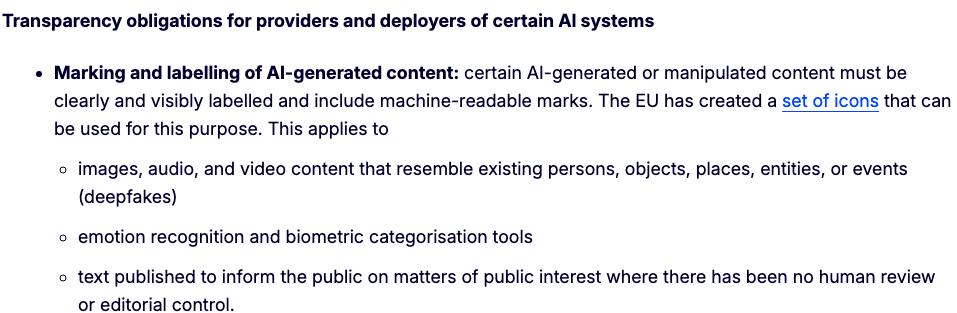
Figure 4: The European Commission's own summary of the labelling duty: certain AI-generated or manipulated content must be clearly and visibly labelled and carry machine-readable marks, including images that resemble existing persons, objects, places, entities or events. Source: European Commission, Safer and more transparent AI, Aug 2026. Screenshot of the source page, captured 26 Nov 2026.
It sets two separate duties, one for the companies that build generative tools and one for the companies that use them.
Whether a particular product image meets the deep fake definition is a legal question. This page does not say either way and is not legal advice.
It applies now. The only transitional period in the amending text is for providers' marking duty.
In New York, an AI version of a model is a legal matter before it is a creative one. The statute also draws a line that matters to studios: routine retouching is not a digital replica.
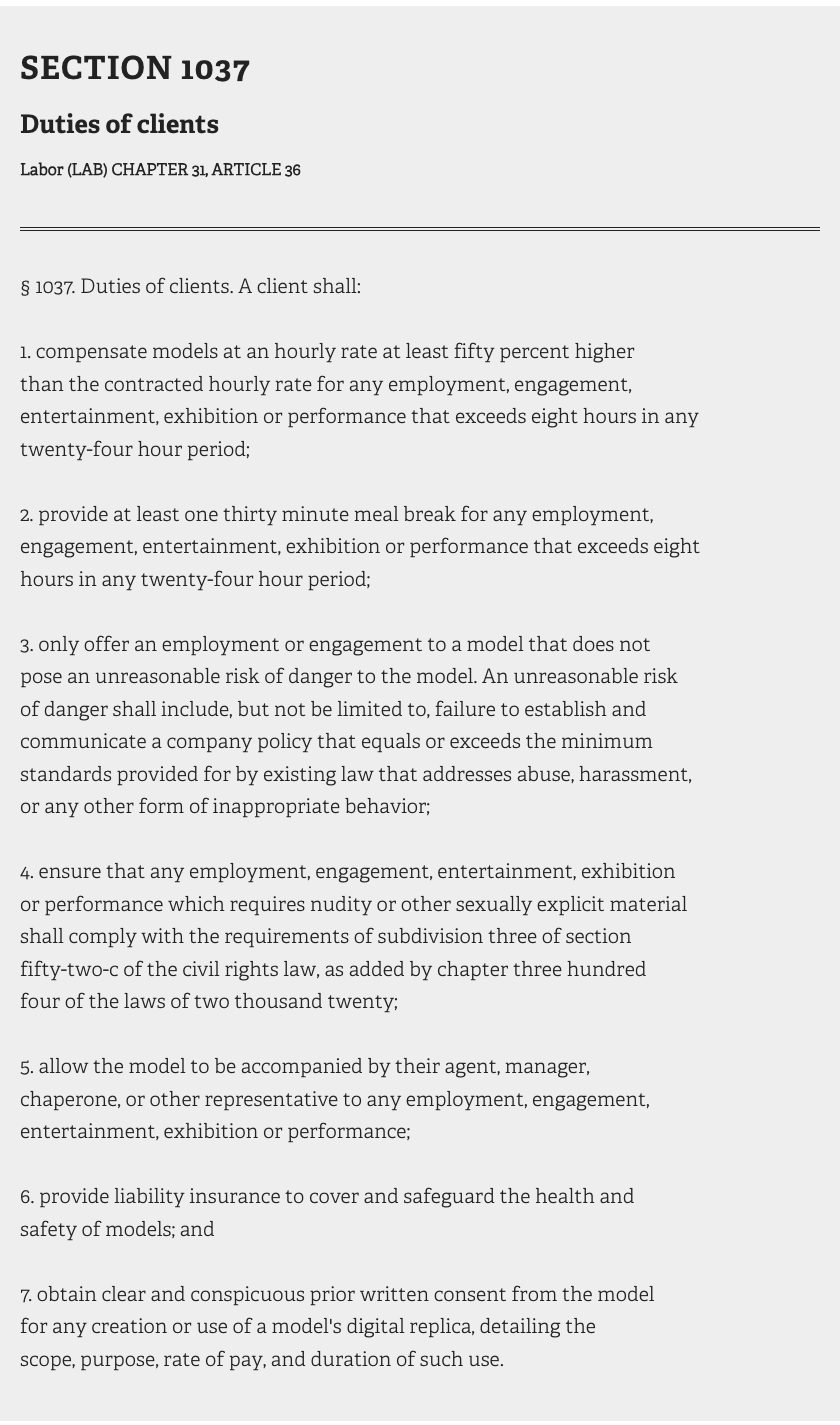
Figure 5: The text of New York Labor Law section 1037: item 7 requires a client to obtain clear and conspicuous prior written consent from the model before creating or using a digital replica. Source: New York State Senate, Labor Law section 1037, Jun 2025. Screenshot of the source page, captured 26 Nov 2026.
The Act regulates modeling services, a term the statute defines to include the use of a digital replica.
None of the sections read for this page states a territorial limit on the client duties in section 1037, so whether they reach a brand outside New York is a question for counsel.
Written, specific and separate consent, with routine retouching carved out.
The duties took effect in mid-2025, with enforcement split between the state and the models themselves.
The clearest public example says models keep ownership.
Surveys link incorrect product content to returns, and some shoppers say they do not feel represented by the models they see. Google reports higher engagement with its virtual try-on images, but its post gives no methodology for the figure. No platform engagement figure newer than September 2024 turned up in the research for this page.
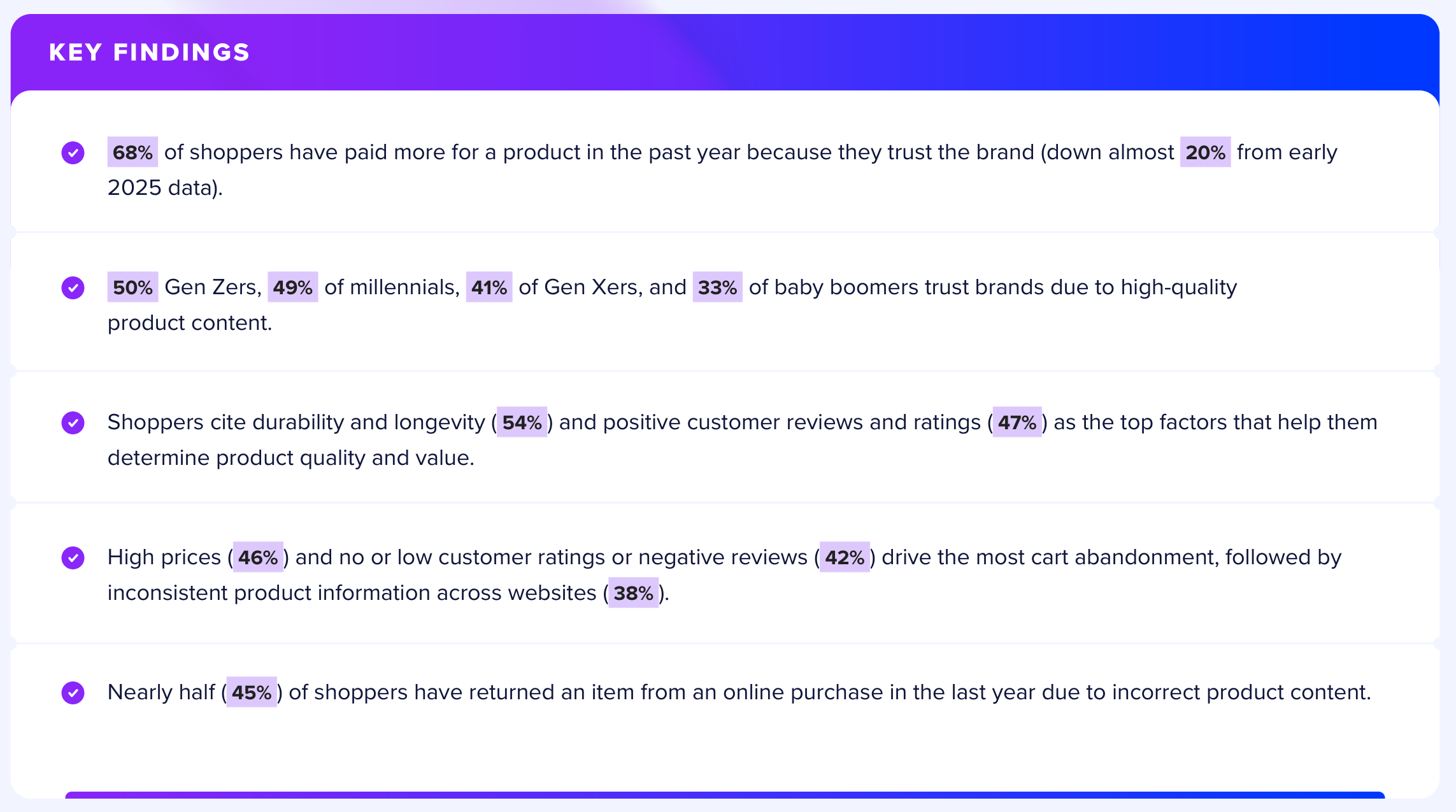
Figure 6: Salsify's 2026 key findings include the share of shoppers who returned an item in the last year because of incorrect product content, alongside findings on brand trust, product quality cues and cart abandonment. Source: Salsify, 2026 Consumer Research Executive Summary, Oct 2025 (survey of 24 to 25 October 2025, 2,712 responses from US, UK and Canadian shoppers). Key-findings panel published by the source, cropped from page 6 and captured 26 Nov 2026.
Two surveys speak to this, and neither tests AI-generated imagery.
Salsify sells product-content software, which gives it a commercial interest in the topic, and neither survey tests AI-generated imagery.
Google reports that it does for its virtual try-on images, but the post gives no data source for the figures.
The post's footnotes cover other claims, not these two figures, and no independent measurement was found. Google's 2023 survey above predates both figures.
Do your AI on-model images match the real garment? Ask Pixofix for a free sample check.
Official projections point to slow shrinkage in the occupations closest to product imagery, and the photographer openings come from replacement rather than growth. Read them as context for planning studio capacity, not as a verdict on AI.
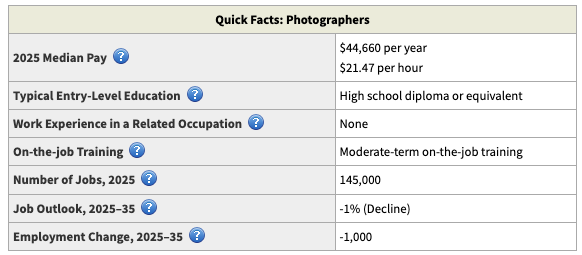
Figure 7: The BLS Quick Facts table for photographers shows median pay, the size of the workforce and a projected decline in employment to 2035. Source: U.S. Bureau of Labor Statistics, Occupational Outlook Handbook: Photographers, Aug 2026. Screenshot of the source page, captured 26 Nov 2026.
Employment is small, pay is modest, and nearly all openings replace people who leave.
Employment is larger and better paid, and the Bureau names AI as a productivity tool.
Every statistic on this page comes from the organisation that produced it: regulators, statute and Official Journal text, government statistics, company results, and original survey publishers. Roundups, vendor blogs and calculators were excluded, and a number that could not be traced to its origin was dropped. Each figure was read on the source page or document. Dates in citations are the date of the underlying data where the source states a month, such as survey fieldwork, a statute revision or an effective date. Where a source gives only a range, we cite the end of the range and state the range in the text, where it gives only a survey year, the text names that year and the citation carries the publication date of the document, and where it gives no data date we cite its publication or last-update date. Citations count sourced data points and statutory provisions; study-design details such as sample size and survey scope are stated in the text with a plain link and are not counted. Three limits shape how to read the page. The adoption survey is Swiss-led. The Google engagement figures are the company's own and date from 2024. The one behavioural test of AI images against original photos is an unreviewed preprint with a small sample. Figure 1 is an original chart drawn from two published forecasts because neither firm's own chart could be captured. This is a statistical summary, not legal advice. The page is refreshed monthly.


