.png)

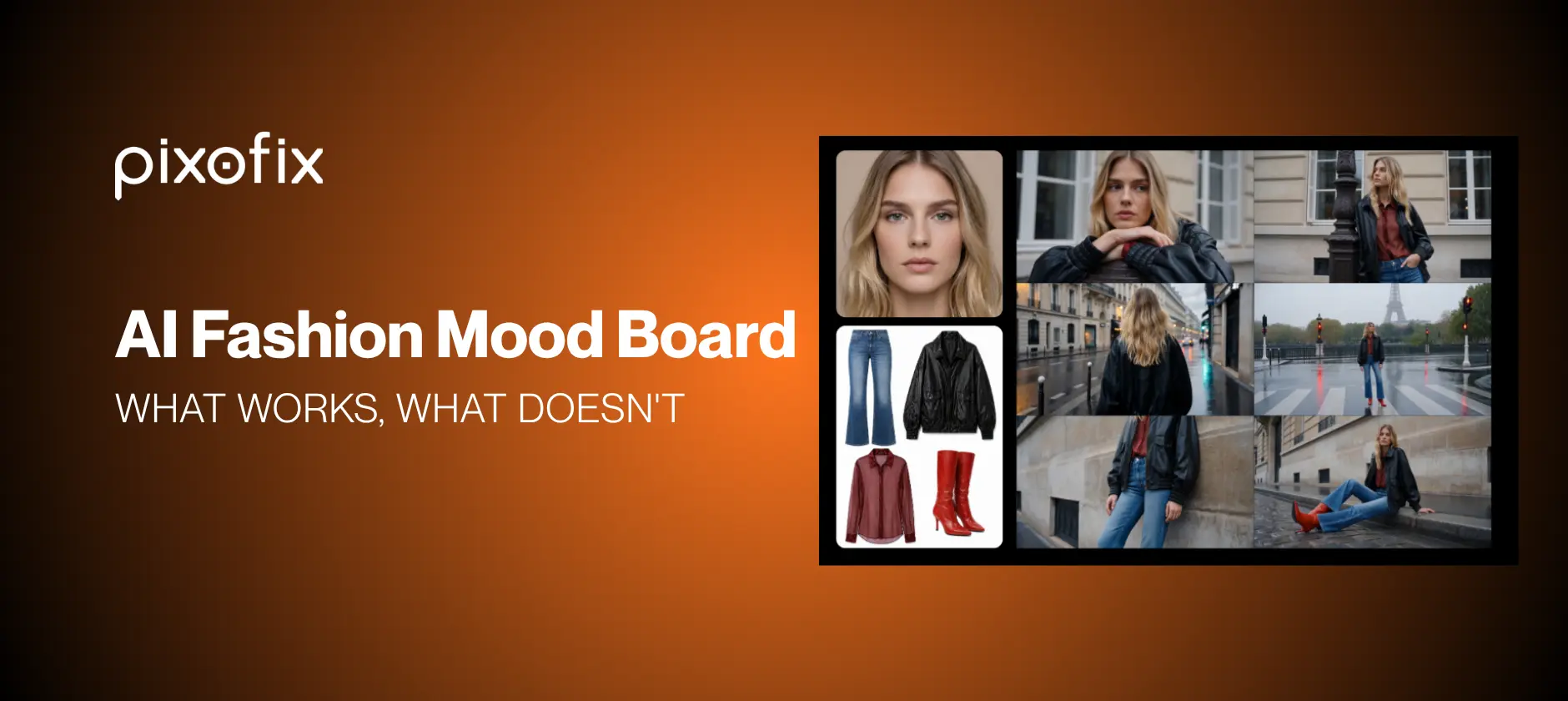
AI Fashion Mood Board: What Works, What Doesn't
AI Fashion Mood Board: How Pre-Production Is Actually Changing
A fashion mood board used to cost a designer real hours before a single sketch existed: pulling references from Pinterest, old shoot contact sheets, and whatever trend report landed that week, then arranging it all into something a merchandiser and a photographer could both read the same way. That step hasn't gone away, but it's the one part of pre-production where generative AI has moved from novelty to genuinely useful faster than almost anywhere else in fashion.
More than 35 percent of fashion executives now report using generative AI in areas including image creation, copywriting, consumer search, and product discovery, according to McKinsey and The Business of Fashion's State of Fashion 2026 report. Mood boards sit squarely inside that image-creation category, and for good reason. A tool like Midjourney or Google's Nano Banana can turn a rough brief into a dozen visual directions in the time it used to take to find three usable references.
That speed is real. It's also easy to overstate. I've spent the past year watching Pixofix's team work the seam between AI-generated concepts and the human production work that has to follow them, and the pattern is consistent: AI compresses the front of pre-production, the part where you're still deciding what a collection should feel like. It does much less for everything after that decision gets made. This piece is about where the mood board step actually gets faster, what the current tools do and don't do well, and where that speed runs into a wall the moment a concept has to become several thousand real product photos before a season deadline.
What AI Mood Board Tools Actually Do (and Where They Differ)
Strip away the marketing language and every AI mood board tool does the same basic job: it takes a text prompt, sometimes an image or two alongside it, and returns a set of visuals meant to represent a theme, palette, or silhouette direction. What separates them is speed, visual quality, and how the images get sourced.
Midjourney remains the reference point for visual polish. It has no free tier at all, hasn't since March 2023, and starts at $10 a month for its Basic plan, with unlimited slower-speed generation only unlocked on the $30 Standard plan. What you're paying for is consistently strong output with minimal prompt engineering, which matters when a mood board needs to look presentation-ready on the first pass.
Nano Banana, Google's image model inside Gemini, works differently. It's free to use inside the Gemini app with daily limits, and paid access comes through Google's AI Plus ($4.99/month) or Pro ($19.99/month) plans rather than a standalone subscription. Its main advantage for concepting is that it can ground image generation in live web search, which is useful when a brief references a specific trend or reference point that needs to look current rather than generic.
Krea AI takes a third approach: instead of one model, it's a workspace covering more than 60 image and video models, including Nano Banana and Flux, behind a single $9-a-month Basic plan, or a free tier capped at 100 compute units a day. For a team that wants to test the same brief across several models before settling on a direction, that consolidation saves the trouble of juggling separate accounts.
None of these tools are fashion-specific. That's worth saying plainly, because a fair amount of the fashion mood board content online comes from vendors selling a purpose-built layer on top of general models, and it's easy to assume that layer is necessary. It usually isn't for the concepting stage itself. A small, technically documented example makes the point: a team of Google Developer Experts published an open-source fashion mood board generator built directly on Gemini's image models, producing a structured 2x4 grid moodboard from a single text prompt, with the full code public. It's not a commercial product, but it demonstrates that the underlying capability is already sitting inside general-purpose tools, not locked behind a fashion-specific subscription.
Where the fashion-specific platforms earn their price is further downstream, linking a moodboard's colors and silhouettes to a tech pack, a bill of materials, or a PLM system. That's a real workflow gap for some teams. It's also a different problem than "how do I get good concept images fast," which is what this section is about.
Where AI Actually Speeds Up the Brief, and Where the Timeline Gets Stuck Again
The honest version of the mood board story is that AI removes a bottleneck at the very start of pre-production and leaves every other bottleneck exactly where it was.
Sourcing and generating references used to take days when a designer was working alone, longer when a brief needed sign-off from merchandising before a stylist could commit to a direction. Cutting that down to an afternoon is a genuine gain, and it's the part of the process these tools are actually built for. But a mood board approved on Monday doesn't produce a single sellable image. It produces a direction. Everything a brand does after that, sampling, shooting, retouching, and getting product photography onto the site before a season deadline, still runs at the pace it always has.
This is worth being blunt about because the gap between AI-assisted pilots and AI-assisted production is a well-documented pattern outside fashion too. MIT's NANDA initiative found that 95 percent of enterprise generative AI pilots fail to deliver measurable financial return, largely because the systems that impressed in a demo were never integrated into the workflow that had to carry the actual output. A fast mood board is the demo. The 3,000 product photos a brand needs shot, retouched, and live before a Q4 drop is the workflow that has to carry it.
That's where I've watched the mismatch actually bite at Pixofix. A creative team can walk into a Q4 planning meeting with concept boards that took an afternoon to build instead of a week, which is real progress. But the moment that concept becomes a purchase order for a few thousand SKUs, the constraint moves from "how fast can we visualize an idea" to "how fast can we get consistent, on-brand images of the real product back from production." Our high-end retouching work exists for exactly that handoff point, campaign and editorial-grade images that need to match the visual direction a mood board set, at a pace that doesn't erase the time AI just saved earlier in the process. And when the volume side of that same deadline is the actual pressure, the constraint isn't creative direction at all, it's getting a large SKU count through retouching at scale without the queue becoming the new bottleneck.
None of this is an argument against using AI for mood boards. It's an argument for being accurate about which part of the calendar it actually shortens. The teams that get the most out of AI-assisted concepting are the ones that use the time it frees up to plan the production handoff earlier, not the ones that treat a fast moodboard as proof the whole season just got easier.
Who's Actually Using AI Mood Boards Right Now
The clearest use cases so far aren't the household-name brand campaigns you'd expect. They're smaller and more specific: stylists and art directors, and independent or emerging designers who don't have a heritage house's archive or budget behind them.
For stylists and art directors, the value shows up before a shoot even happens. Instead of describing a lighting or wardrobe direction verbally to a crew, an AI-generated reference frame lets them show it, which cuts down on the kind of on-set misinterpretation that leads to reshoots. Fashion Week Online reported that this pre-visualization step is becoming particularly common among stylists, precisely because their job already depends on communicating a feeling to a team before anything is built.
For emerging designers, the effect is more structural. A well-produced mood board used to require either strong personal image-sourcing instincts or a paid stylist, and both cost something a heritage brand doesn't have to think about. According to the same reporting, that gap narrows in aesthetically specific, still-uncatalogued corners of the market, particular subculture revivals or niche menswear directions, where the reference pool is thin enough that AI-assisted sourcing offers a real head start rather than a shortcut around real research.
It's worth being direct about what isn't confirmed here. I haven't found a named major brand publicly detailing its mood board workflow in verifiable trade press, and I'm not going to imply one exists. What's consistent across the reporting that does exist is smaller-scale and role-specific: this is a tool stylists, art directors, and independent designers have picked up because it solves a real time problem in their specific part of the job, not a wholesale replacement for how collections get conceived.
Where AI Mood Boards Fall Short
The limitations aren't hidden, they just don't get much airtime in tool marketing.
The most consistent one is sameness. AI image models draw from overlapping training data, so two teams working from similarly worded prompts can land on visually similar boards without either one copying the other. That's a real problem for a brand trying to establish a distinct point of view, and it's the reason experienced users treat AI output as a starting point to edit and combine, not a finished direction to accept as-is.
Brand and color consistency is a related issue. A single AI-generated image can look exactly right, but stringing together a full board where the palette, lighting logic, and styling read as one coherent story across a dozen images is harder than it looks, and it's exactly the kind of consistency problem that the same underlying models tend to introduce once you're producing dozens or hundreds of images rather than a handful of hero shots. This is the same failure mode that shows up later in AI-generated product photography at volume, just at an earlier and lower-stakes stage.
There's also a legal question worth flagging plainly, and I want to be direct about its limits: I'm not a lawyer, and this isn't legal advice. In the United States, the Copyright Office has been consistent since its March 2023 guidance that copyright protection requires human authorship, and that material an AI system generates on its own, including from a detailed prompt, isn't eligible for copyright on its own. The Office reaffirmed this in its January 2025 report on copyrightability, and the U.S. Supreme Court left that position in place when it declined to hear Thaler v. Perlmutter in March 2026. Practically, that means a mood board built entirely from AI-generated images may not be protectable as-is under U.S. law, though a human's subsequent selection, arrangement, or substantial editing of that material can be. If a mood board or its assets are going to be reused in ways that matter for ownership, brands outside the U.S. should check their own jurisdiction's rules rather than assume this applies uniformly, and anyone with a real ownership question here should talk to counsel rather than rely on a blog post, including this one.
None of this makes AI mood boards a bad tool. It means treating the output the way you'd treat a strong first draft: useful, fast, and not the final word until a person has actually shaped it into something specific to the brand.
What's Next for AI in Fashion Mood Boards
The near-term trajectory is less about mood boards becoming smarter and more about them becoming less isolated from what happens next.
The clearest signal is tools grounding generation in real information rather than pure pattern-matching. Google's Nano Banana 2, released in February 2026, pulls from real-time web search to render more accurate, current references instead of relying only on what a model learned during training. For a mood board meant to reflect an active trend or a specific real-world reference, that's a meaningful shift from earlier tools that were more likely to generate a generic approximation of "streetwear" or "coastal" than something that actually reads as current.
The broader pattern McKinsey points to is fashion moving away from AI as a set of disconnected tasks. To date, most fashion AI applications have focused on siloed tasks such as copywriting, image generation, and customer service, but leaders are now looking to integrate AI across their businesses, according to The State of Fashion 2026. Applied to pre-production specifically, that likely means less "generate a mood board in one tool, then start over in the next stage" and more platforms attempting to carry a visual direction, its colors, and its references forward into tech packs and briefs without a separate manual handoff.
I'd hold that second trend a little loosely. Plenty of platforms already claim to do this, and claiming it and doing it reliably at production scale are different things, which is exactly the gap the MIT research on stalled AI pilots points to. The realistic expectation for the next year isn't that mood boards get reinvented. It's that the tools generating them keep getting faster and more accurate at the one job they're actually good at, and the harder problem of connecting that output to everything downstream stays a people-and-process problem for a while longer.
Is an AI Fashion Mood Board Worth It?
AI has earned its place in the mood board step. It hasn't earned the broader claim sometimes made on its behalf, that pre-production itself has been transformed. Those are different things, and the gap between them is where a lot of brands are going to lose time if they're not paying attention.
The teams getting real value out of this are treating the time savings as exactly that: time saved on one step, to be reinvested in planning everything that comes after it, not proof that the whole season just got easier. A mood board approved in an afternoon instead of a week means a brand can lock creative direction earlier and give production more runway before a Q4 deadline. Whether that runway actually gets used is a production and retouching capacity question, not a concepting one, and it's worth asking now rather than in October.
If your team is planning around a season where the creative direction is coming together faster than usual, that's the moment to have the conversation about your production capacity sorted before volume becomes the bottleneck the mood board never was.



.png)
.png)
