.png)

Top Alternatives to The New Black AI for 2027
Understanding The New Black AI
The New Black positions itself as an end-to-end platform to "run your fashion brand with AI," and the feature list backs that up. It covers AI fashion design from text prompts, sketches, or reference images, fabric and color transformation, ghost-mannequin and flat product shots, AI fashion model generation and virtual try-on, an AI Tech Pack generator that auto-fills factory-ready specs, a Brand DNA tool meant to keep visual identity consistent across generations, and moodboard and lookbook creation. It also publishes directly to Shopify, Instagram, TikTok, YouTube, and Pinterest, and offers a Claude MCP integration for creating inside a conversation. Team collaboration comes with no extra seat fees, which is a genuine point in its favor for growing design studios watching headcount-linked software costs.
That breadth is the platform's real strength: design, visualization, and production-adjacent tasks (tech packs, brand consistency) live in one place instead of three or four disconnected tools. The tradeoff, and the reason people go looking for alternatives, is the same one that shows up across almost every all-in-one AI platform: covering that much ground in one product means each individual piece, whether that's the design generation, the try-on quality, or the tech pack automation, competes against tools built to do only that one job well. Whether that tradeoff is worth it depends on how much of the platform's breadth a given brand will actually use versus how much specialized depth they need in the one or two areas that matter most to them.
Top Alternatives to The New Black AI
Pixofix
Pixofix isn't a New Black competitor in the software sense. We don't sell a design platform for your team to generate from and review. You send us your product photos and creative direction, and we return finished, brand-consistent visuals, using an AI and human hybrid process rather than an unsupervised model.
That distinction matters most at the exact point where an all-in-one design platform starts to strain: once a brand has already settled its design direction and the real bottleneck is producing consistent, QC'd visuals across a full catalog and every seasonal drop, not generating more design concepts. I've spent eight years working in fashion, and every project we run pairs AI artists, AI engineers, and garment experts, with AI plus human QC on every single visual before delivery. For Birdy Grey, that structure meant a three-step quality control process, initial retouching, color matching against samples, and a final QC pass, that cut color-related revisions by 40 percent and post-delivery fixes to under 5 percent, while product return rate dropped 32 percent on the back of more accurate color representation.
We work as a pure production partner too. If your creative direction is already set, whether that came from your own team or an outside agency, and what you actually need is AI visual output at volume with real consistency between images, that's the part of the process we take on regardless of catalog size. If you're still deciding what your brand's AI-generated look even is, a design-generation platform is the right starting point. If you already know, and the problem has become producing it consistently at scale, that's what our AI Lifestyle and high-volume retouching services are built around.
Best for: fashion and e-commerce brands with an established creative direction who want finished, QC'd AI visuals delivered as a product at volume, not another design platform to generate from and review themselves.
Trayve
Trayve is a no-code virtual try-on and content platform built around one uploaded product photo feeding three outputs: virtual try-on across 22 AI models on paid plans (six on the free tier, up to six poses each), PostReady social content across eight photography themes and 17 lifestyle backgrounds, and ShopReady product shots across 12 angles and 10 solid backgrounds. Everything generates in about 60 seconds without API keys or developer setup. Pricing runs Free (5 complete images, no card required), Creator at $29 a month, Pro at $89 a month, and Enterprise at $199 a month, with PostReady and ShopReady included on every paid tier.
Best for: brand owners who want virtual try-on, social content, and product shots generated from the same source photo without touching code or a developer.
Next in Fashion
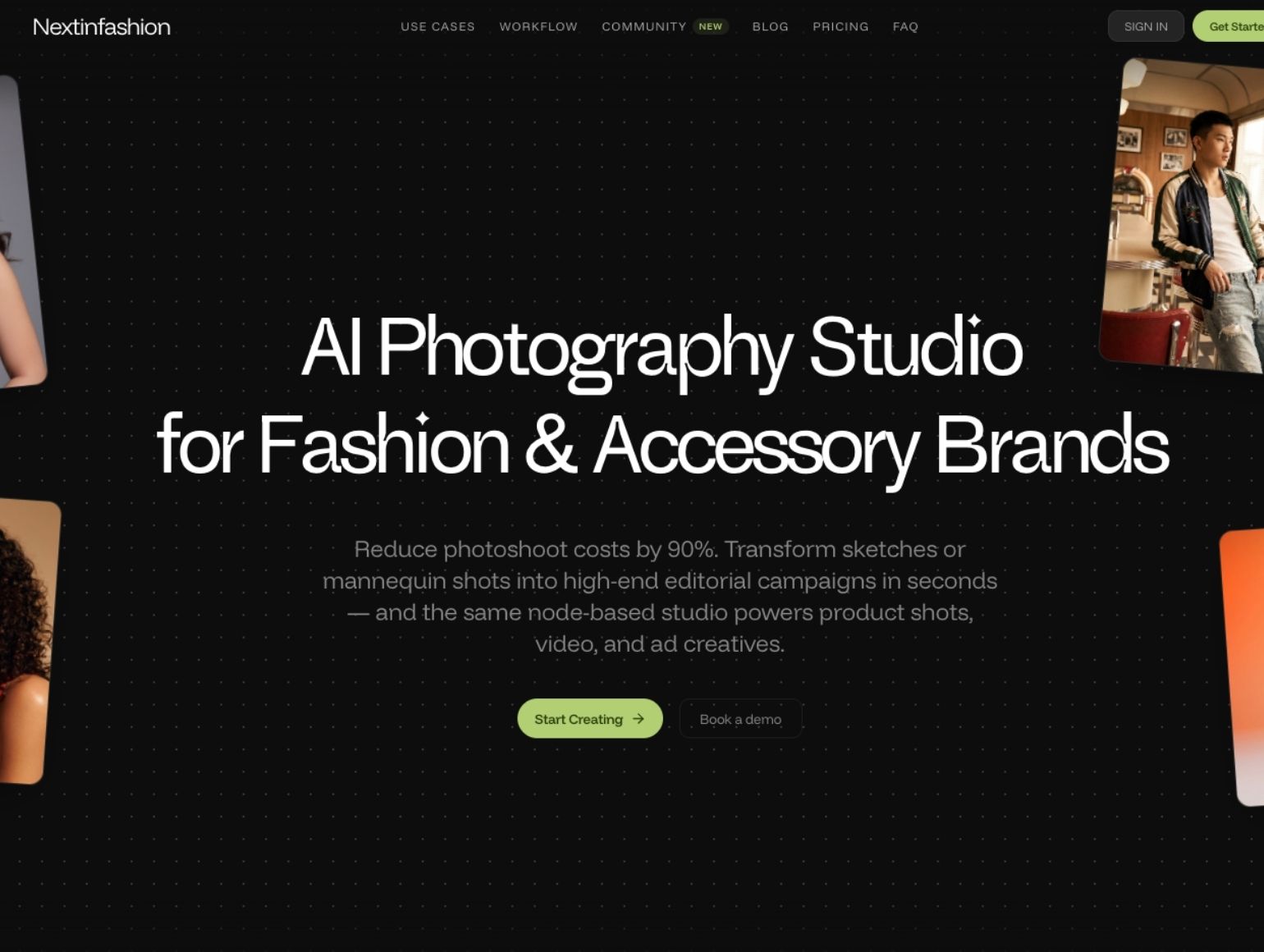
Next in Fashion (also referenced as NIF) uses a node-based canvas where silhouette, fabric, color, and pattern are separate editable nodes rather than tabs you switch between, and it converts sketches or mannequin shots directly into editorial-style campaigns, generating product photography, video, and ad creatives from a single reference. Real-time collaboration on shared moodboards is built in. Pricing is entirely credit-based with no subscription: 1 credit for 1K/2K image generation, 2 credits for 4K, 5 for 720p video, 10 for 1080p video, and 20 for 4K video, credits never expire, and new accounts get 10 free credits to start. Its own marketing claims a 90 percent cost reduction versus traditional photoshoots and "100x speed to market," figures worth treating as vendor positioning rather than an audited benchmark.
Best for: teams that want a collaborative, node-based design workflow and prefer paying only for what they generate over a recurring subscription.
Style3D AI
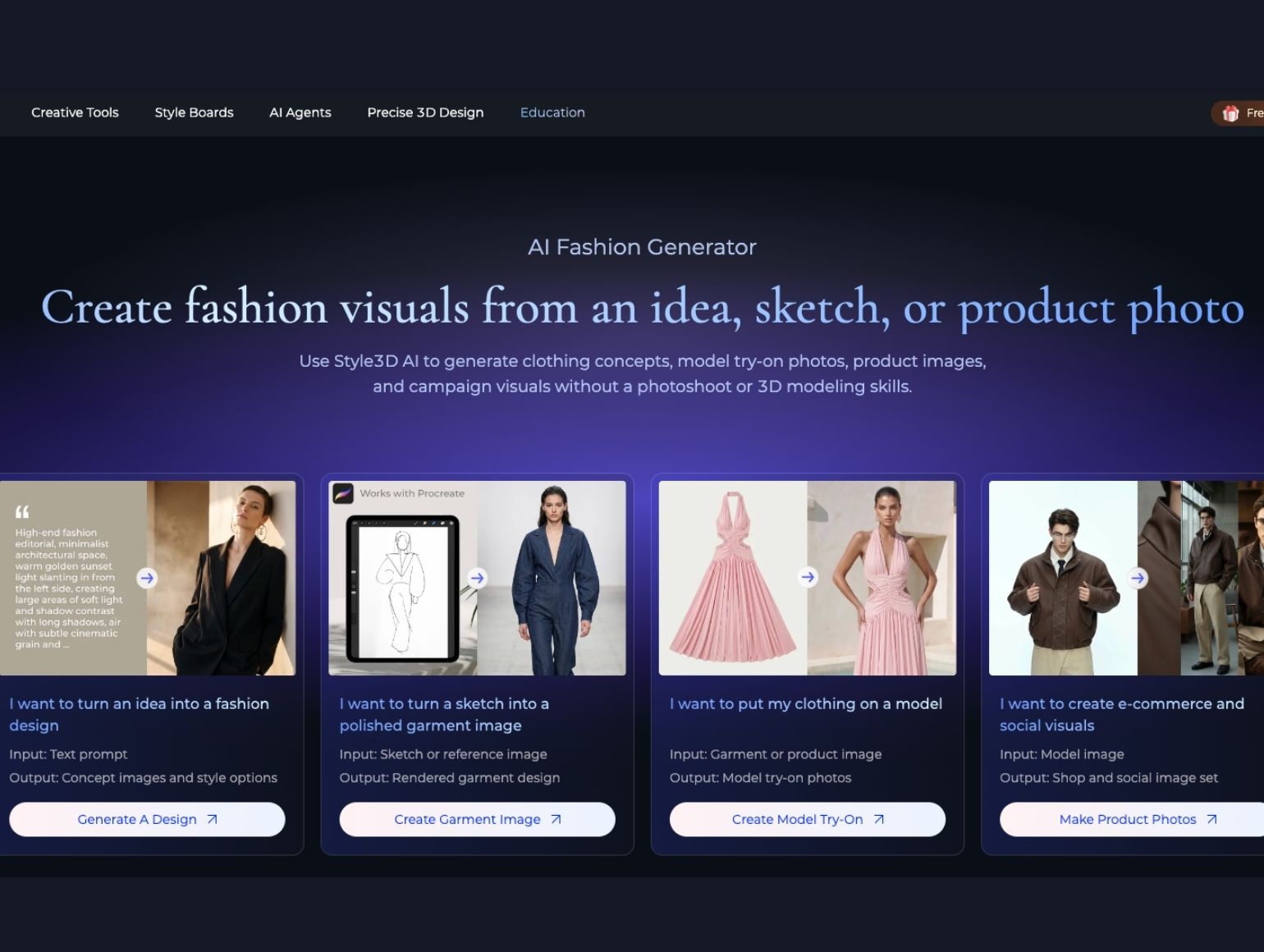
Style3D AI centers on turning concepts into production-ready assets before any physical sampling happens: Text to Design and Sketch to Design for garment concepts, virtual try-on, an AI print generator, an AI photoshoot tool for product and campaign scenes, and guided AI agents across fashion, apparel, fabric, and toy-specific workflows. It's aimed at fashion designers cutting sample counts, e-commerce sellers, and even students building portfolios. Style3D AI doesn't publish self-serve pricing tiers on its site, in the FAQ it poses the question "Is Style3D AI free to use?" without a visible answer in what's publicly accessible, so budget-conscious teams should confirm current pricing directly before counting on a specific plan.
Best for: designers who want to iterate on concepts and cut physical sample counts before committing to production, more than teams looking for finished marketing content.
Mercer (formerly CALA)
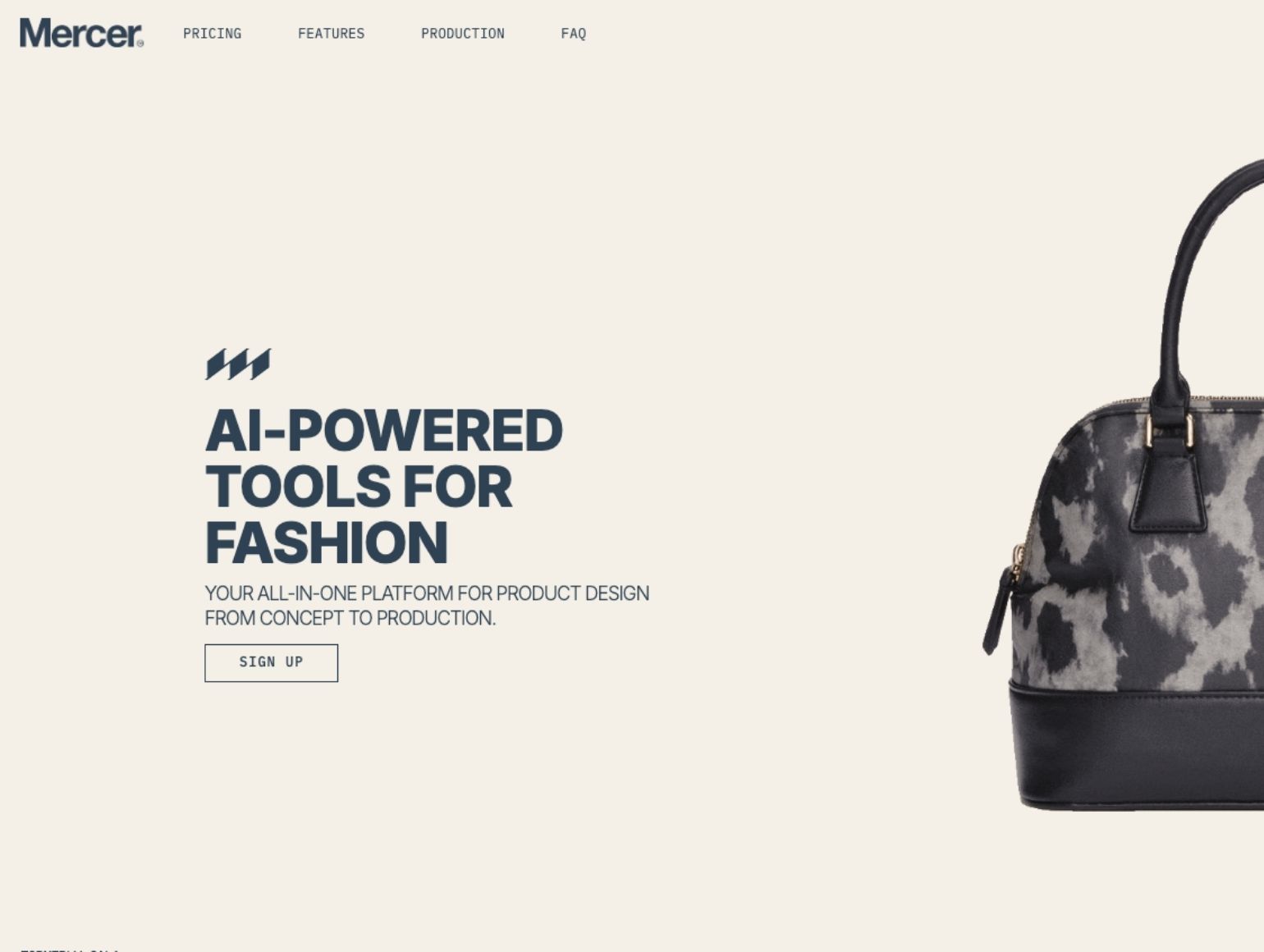
Mercer, rebranded from CALA, pairs generative AI design tools (text-to-image, an AI paintbrush, product variations, custom fine-tuned models trained on a brand's own imagery) with actual production coordination: centralized asset management, team collaboration with measurements and task assignments, and connections to manufacturing partners for print-ready files. Pricing runs Designer at $19 a month (one seat, 300 AI credits), Studio at $69 a month (three seats, 1,200 AI images, team access), Studio Pro at $159 a month (five seats, 2,400 AI images, task management, production templates), and Enterprise starting at $499 a month (ten seats, 3,000 AI images, access to Mercer's in-house design and manufacturing network).
Best for: independent designers or small fashion houses who want design generation bundled with a real path to sample production and manufacturing, not just marketing visuals.
Detailed Comparison: Features and Pricing
Here's how all five compare side by side.
The five split into genuinely different jobs rather than five versions of the same tool. Trayve and Next in Fashion both lean toward finished marketing content, virtual try-on and social- or ad-ready output, though Trayve's fixed subscription tiers are easier to budget against than Next in Fashion's pure credit model if your volume is steady month to month. Style3D AI and Mercer both sit earlier in the process, closer to concept and sampling, with Mercer going a step further into actual manufacturing coordination that Style3D AI doesn't offer. None of the four publish a human quality-control step as part of the product, the review remains the brand's job in every case. Pixofix is the outlier by design, it's not a generation tool at all, it's a production service where QC is built into the deliverable rather than left to the buyer.
Learning curve tracks roughly with scope: Trayve's no-code, single-upload workflow has the shortest ramp-up, Next in Fashion's node-based canvas and Mercer's fuller production toolkit both ask for more time to learn what each panel does, and Style3D AI sits in between depending on which of its six tools a given team actually uses.
User Experiences and Case Studies
I want to be direct about what's verifiable here and what isn't. None of the four platform alternatives above currently have a meaningful independent review base, CALA's own G2 listing shows zero submitted reviews under the Mercer rebrand, and I couldn't locate a substantial, verified review presence for Trayve, Next in Fashion, or Style3D AI either. That's common for newer or recently rebranded AI tools, but it means I'm not going to manufacture user testimonials or success stories for them that I can't stand behind. If you've used any of these four directly, that firsthand read is worth more than anything a vendor's own site says about itself.
[EXPERIENCE NEEDED: Add a verified user story or case study for Trayve, Next in Fashion, Style3D AI, or Mercer once one is available and confirmed.]
What I can speak to directly is Pixofix's own record. The Birdy Grey engagement is a useful example specifically because it's a consistency problem, not just a volume one: hundreds of images across multiple product drops on a tight timeline, with color accuracy as the recurring failure point that traditional and DIY workflows kept missing. The three-step QC process we built for that account is the same structural idea behind every project we run, generation and review aren't separate steps you have to manage yourself.
How to Choose the Right AI Tool for Your Business
Three factors decide this more than any feature checklist. Business size and team structure matter first: a solo designer or small studio benefits from Mercer's lower-tier seats or Style3D AI's per-tool flexibility, while a brand running seasonal drops across a real SKU count runs into the same wall every DIY tool eventually hits, someone still has to review and fix what the AI generates, and that job doesn't scale linearly with a subscription tier.
Specific need is the second factor, and it's worth being precise about which stage of the process is actually the bottleneck. If the problem is generating design concepts faster, Style3D AI or Next in Fashion's canvas fits. If the problem is turning one product photo into try-on and social content without a developer, Trayve fits. If the problem is getting from concept to an actual manufactured sample, Mercer's production network is the differentiator. If the problem is producing finished, consistent visuals at volume without your team reviewing every output, that's a different category of solution entirely, and it's the one none of the four DIY tools here are built to solve.
Budget is the third factor, and it splits two ways across this comparison: Trayve and Mercer use predictable tiered subscriptions, easier to forecast against a marketing budget, while Next in Fashion's pure credit system rewards unpredictable or seasonal usage and penalizes steady high-volume use less transparently than a flat tier would. Before committing to an annual plan on any of them, map your actual expected monthly output against the credit or seat limits rather than the headline price.
A short evaluation checklist: confirm what stage of the design-to-production process you actually need help with, test the free tier or trial against a real product from your own catalog rather than a demo asset, ask directly whether the AI output needs a review pass before it's usable (every tool in this comparison except a managed service says yes), and price out your actual monthly volume against each tool's credit or seat structure before you commit annually.
Future Trends in AI Fashion Design
The clearest direction across this category is convergence: tools that started as pure image generators (Style3D AI, Next in Fashion) are adding production-adjacent features, while production-focused platforms like Mercer are adding more generative design capability. That's the same pattern The New Black itself represents, consolidating design, visualization, and go-to-market steps that used to require separate vendors.
The harder open question is what stays a human job as these tools get better. Design ideation, color matching against physical samples, and catching the specific artifacts AI still produces (texture drift, inconsistent lighting across a set, a pose that doesn't quite read right) remain places where a trained eye catches what an automated review doesn't, and that's true whether the AI model behind a given tool improves or not, since it's a quality-control function, not a generation one.
On sustainability and ethics, the most concrete near-term shift is fewer physical samples and photoshoots, which several of these platforms already lead with as a cost argument, and that has a real environmental upside worth taking seriously alongside the cost one. The harder, less resolved questions, model consent and likeness rights for AI-generated fashion models, and disclosure requirements for AI-generated imagery under frameworks like the EU AI Act, are active regulatory areas rather than settled ones, and any brand using these tools commercially should track current guidance from official sources rather than assume last year's rules still apply.



.png)
.png)
