.png)

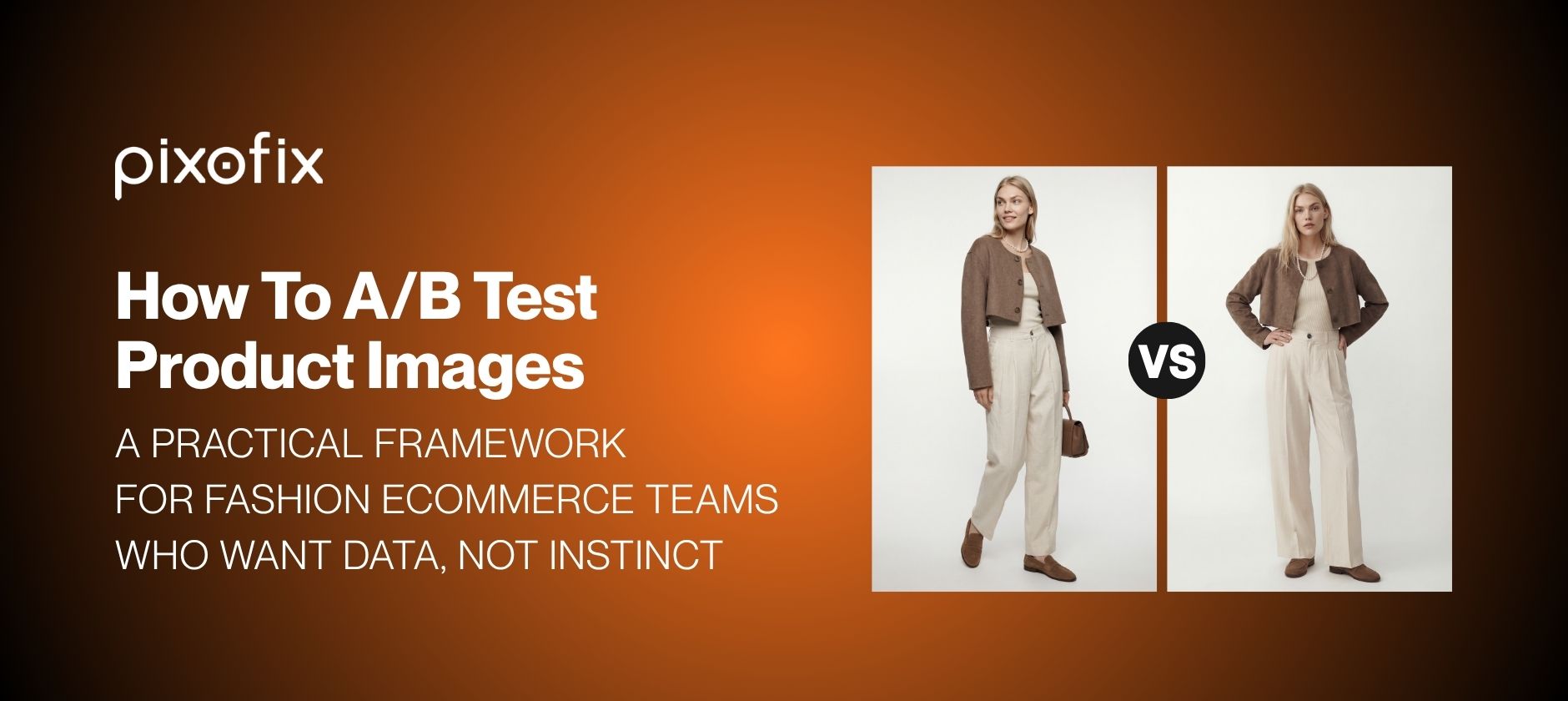
How To A/B Test Product Images: A Practical Framework For Fashion Ecommerce Teams Who Want Data Not Instinct
Most fashion product image A/B tests fail because the image pipeline is noisy, not because the idea is bad. Lighting shifts between batches, colorways drift across shots, ghost mannequin shaping changes by retoucher, and suddenly your “winner” is just a production glitch dressed up as insight.
If you run 500 to 10,000 SKUs per month, your constraint is not creativity. Your constraint is repeatability under SLA pressure. Learning how to A/B test product images in this context is less about split testing software and more about building a workflow that keeps visual variables isolated and controlled at catalog scale.
This guide is for studio managers, creative directors, and ecommerce leaders who already work daily with PDPs, PLPs, and attribution. The focus is operational: how to design clean variants, keep QC loops tight, and combine AI speed with human judgment so your data is worth trusting.
Why Product Image Tests Fail
Most teams assume the weak link is statistics. In practice, the weak link is production drift. You can hit your sample size and p value and still ship a false winner because your images were inconsistent.
The question is simple: are you testing an image concept or an image pipeline. If the pipeline is unstable, every “test” becomes a noisy audit of your post production bottlenecks instead of a meaningful experiment.
Spot Catalog Scale Drift
Catalog scale drift appears when the same style, shot two weeks apart, feels like a different garment. Small changes in white balance in Capture One, inconsistent clipping paths from different vendors, or AI texture mapping quirks from a new LoRA training checkpoint all stack up.
You notice it when:
- A colorway looks colder on PLP than on PDP
- Shoulder shapes on ghost mannequin shots shift subtly across sizes
- Jewelry reflections fluctuate by SKU in mixed metal sets
- Skin texture jumps from “plastic” to “pore rich” across adjacent rows
If you test a new hero image while these issues are live, your “variant” is really a bundle of uncontrolled changes. Audit a representative catalog slice monthly, then fix pipeline drift before trusting any experiment. Use side by side comparisons within your DAM to review entire size runs and colorways, not just single SKUs.
Isolate One Visual Variable
You cannot interpret a test where background, crop, model pose, and retouching style all change together. That is roulette, not experimentation.
For fashion ecommerce, the visual variables that usually matter most are:
- Composition: angle, crop, zoom, model versus ghost mannequin
- Context: background color, studio versus lifestyle, prop density
- Detail emphasis: fabric closeups, back views, fit on different body types
- Consistency cues: alignment across colorways and sizes
Pick one primary variable per test. For example, adjust crop tightness on the PDP hero image while keeping lighting, background, retouching grade, and model identical. Write a brief that specifies what cannot change and enforce it through QC loops that compare control and variant side by side before launch.
Set Clear Business Goals
Image tests should link to specific commercial outcomes, not vague “creative preference.” The outcome determines both the variable and the measurement window.
Examples you can operationalize:
- Reduce returns on fitted denim by making fabric stretch and rise more explicit in PDP galleries
- Increase add to cart rate on PLP for outerwear by making silhouette readable at a glance
- Improve click through rate on prospecting ads for occasionwear with stronger shape communication
Write the business goal before briefing creative or prompting AI. If the goal is return reduction, testing only background color is probably noise, even if the images feel different. Align every test with a metric that matters to your margin structure and merchandising plan.
How To A/B Test Product Images
Learning how to A/B test product images in fashion starts with selecting the right variable, framing a sharp hypothesis, and building a clean control and variant that your tooling can serve predictably.
Choose The Highest Impact Variable
Not every visual issue deserves a test. Some items should be standardized immediately, for example, fixing clear color drift or broken clipping paths.
Prioritize variables that:
- Affect first glance understanding of product class and fit
- Address known objections, for example, “Is this see through” or “How long is it”
- Change how the product is scanned or ranked on PLP grids
- Are hard to infer from text, filters, or size guides
For instance, switching from flat lay to on model for dresses will usually move both CTR and conversion more than shifting a studio grey background from 6 percent to 8 percent brightness. Test the macro framing decisions first, then iterate on micro details.
Write A Testable Hypothesis
A useful hypothesis predicts how a specific visual change will move one metric for one product set on one surface.
Good pattern:
“If we [change X visual element] for [Y product set] on [Z surface], then [metric] will move [direction] because [reason].”
Example:
“If we switch hero PDP images for structured blazers from front on to 45 degree angle, then add to cart rate will increase because shoppers can judge shoulder structure and waist suppression more accurately.”
This structure forces you to define:
- The product subset, such as tailored blazers only
- The surface, such as desktop PDP
- The primary success metric, such as PDP view to add to cart
Document hypotheses in a simple testing log, and do not start production until everyone agrees on the wording.
Build Control And Variant Sets
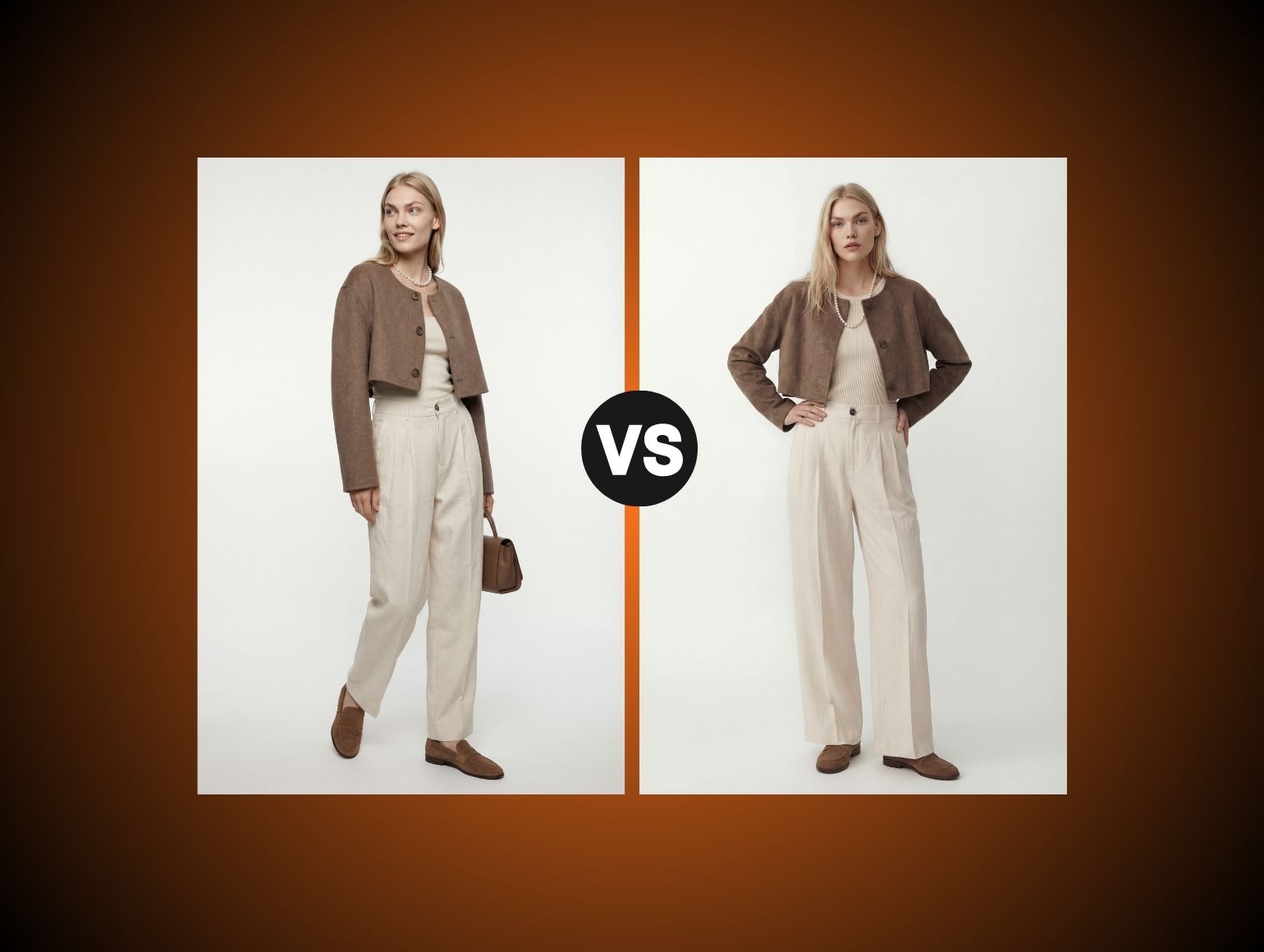
Controls should reflect your current standard. Variants should introduce the smallest possible change that isolates the test variable.
Operational guidelines:
- Use identical file specs, naming conventions, and storage paths for control and variant
- Lock retouching recipes: same contrast curve, skin treatment, sharpening, and texture handling
- Ensure all images pass the usual QC process before they enter the test environment
If you rely on AI tools such as Flux Pro, Stable Diffusion, or Runway Gen 4 for backgrounds or virtual models, freeze the prompt, seed, and LoRA training snapshot after locking the control. Then adapt only the element you intend to test, such as camera distance or crop, while keeping the rest of the generative setup stable.
How To A/B Test Product Images At Scale
Running one test on thirty SKUs is trivial. Running repeatable tests on five thousand SKUs inside a 24 to 48 hour SLA is where systems crack.
Prioritize Hero, Background, Angle
Begin with surfaces that carry most traffic and revenue. Typically, these are:
- PLP thumbnails and hero tiles
- First frame PDP hero images
- First frame images for high spend ad campaigns
Within those surfaces, the highest impact levers are:
- Hero framing: model versus ghost mannequin versus flat lay
- Camera angle and distance
- Background treatment
Create a testing ladder. Step 1: hero framing. Step 2: background. Step 3: angle or pose. Roll each winning pattern into your style guide before advancing to the next rung. This avoids running three overlapping tests on the same SKUs and losing interpretability.
Separate PDP, PLP, And Ads
“Product images” is not a single channel concept. PDP behavior, PLP scanning, and ad engagement respond differently to identical compositions.
Consider these patterns:
- Tight fabric crops work on PDP for knitwear, but underperform as PLP thumbnails where silhouette recognition dominates
- Lifestyle imagery can win hard in paid social yet underperform in organic PLPs where shoppers expect studio consistency for comparison
- Ad units subject to aggressive compression can distort subtle color differences that matter on PDP
Define tests by surface. A PLP background experiment should not quietly change PDP at the same time. Use separate test IDs and creative briefs, and keep reporting split by surface so decisions stay precise.
Match Tests To Traffic Volume
Many fashion teams design tests that their traffic can never support. A subtle angle experiment on niche category SKUs might not converge before the next collection drop.
Practical rules of thumb:
- High volume evergreen categories, such as denim, tees, and underwear, can support multiple concurrent tests by product segment or device
- Seasonal capsules and limited drops should run one or two big swing tests, usually around hero framing and color clarity, then standardize quickly
- For low traffic long tail SKUs, default to the current global winner without attempting granular tests
Use sampling calculators for guardrails, but let your merchandising cadence lead. Do not configure a 6 week image test on SKUs that will be rotated out in 3 weeks.
What To Measure First
Image tests produce impressive dashboards quickly. The risk is collecting beautiful but indecisive data. Start with a tight KPI stack aligned with how your business earns money.
Track Add To Cart Rate
For most fashion ecommerce teams, add to cart rate at PDP or PLP level is the clearest signal of image performance, since it sits upstream of payments, promos, and shipping friction.
Measure:
- PLP click to PDP view
- PDP view to add to cart
- Add to cart to checkout start as a sanity check
When comparing control and variant, confirm that traffic quality is balanced by device, channel, and geo. A higher add to cart rate driven by a variant that happens to over index on a particular low intent traffic source can mislead you. Use basic stratification or weighting in your analysis if the mix shifts mid test.
Watch Conversion And Revenue
If volume permits, validate add to cart gains with completed orders and revenue per session. This matters especially where image changes influence expectations that drive returns.
Track:
- Session to order conversion rate for the tested SKUs
- Revenue per PDP view
- Gross margin impact if the variant shifts mix toward higher or lower priced items
Include guardrails such as return rate, exchange rate, and cancel rate where your systems provide timely data. Some “high converting” variants simply attract customers who misunderstood fabric weight, opacity, or fit because the imagery over promises.
Segment By Device And Channel
The same image behaves differently on mobile search, desktop direct, app traffic, and paid social. Ignoring this hides actionable opportunities.
At minimum, segment results by:
- Mobile versus desktop
- Email, paid social, organic search, and app
- New versus returning visitors for core categories
For example, a closer crop might help desktop shoppers inspect stitch detail yet reduce scan quality in dense mobile PLP grids. Your final recommendation could be device specific assets or dynamic selection rules instead of a single “winner” image.
Why AI Alone Breaks Down
AI tools are extremely effective for generating 1 to 10 image variants quickly. Problems start when teams try to apply the same approach to 500 to 10,000 SKUs per month without a stabilizing control layer.
Image generation and editing systems such as Flux Pro, Stable Diffusion, Imagen 3, and Runway Gen 4 are probabilistic. Without tight prompt discipline, documented LoRA training states, and human review, they introduce noise that overwhelms the effect you intend to test.
Catch Lighting Drift Early
One of the most common AI artifacts at catalog scale is lighting drift. Small shifts in key to fill ratios, highlight rolloff, and shadow density across batches create inconsistent perceived quality.
You see it when:
- AI model shots for the same dress look warmer for size S than for size L
- Specular highlights on leather wander around the surface, breaking realism
- Jewelry and patent accessories either blow out to pure white or slump to grey in unpredictable ways
Batch prompts such as “studio lighting, soft shadows” are not enough. Build a lighting reference library using HDRI maps, 3D lighting rigs, or canonical reference frames, and review entire collections side by side on calibrated monitors. Reject or reprocess any batch that drifts outside approved ranges.
Prevent Color And Fit Errors
Color accuracy is non negotiable in fashion, yet generative tools often hallucinate or drift from brand color standards, particularly across colorways or complex textiles.
Common issues include:
- Hue shifts that make “ivory” look like “cream” or “sand” in certain sizes
- AI adding unrealistic gloss to satin or metallics
- Distorted fit in ghost mannequin images, such as warped shoulders or implausible waist cinching
AI pipelines perform acceptably at 1 to 10 images because an art director can inspect each output manually. At catalog scale, 500 to 10,000 SKUs per month, they tend to fail with lighting drift, color inconsistency, and garment distortion unless there is strong human QC. Treat AI as a rapid generator, then use defined retouching standards and human review to keep experimental images from corrupting your A/B test signal.
Avoid False Winners
With an uncontrolled AI pipeline, your tests measure inconsistency rather than preference. A variant may “win” because it accidentally benefited from nicer color, smoother skin rendering, or a more flattering AI pose, not because the tested variable was effective.
These false winners lead to:
- Style guides built on accidental artifacts
- Creative directions for future seasons that no longer reproduce the original result
- Frustration, since the same prompts produce different looks when the underlying model updates
Reduce this risk by locking model versions when possible, documenting prompts and negative prompts, freezing LoRA training snapshots for each test, and adding QC checklists that compare control and variant beyond the intended change. Only run an analysis once these checks pass.
Use AI And Humans Together
The solution is not to abandon AI, but to treat it as a high speed engine supervised by experienced humans. Use AI for production acceleration, then rely on people for nuance and brand judgment.
Generate Variants Faster
For variant generation, AI can compress work that previously required reshoots or complex compositing.
You can:
- Produce alternative backgrounds for flat lay shoes and bags in minutes
- Create virtual models at multiple sizes from a single base capture
- Generate angle variations for PDP galleries without reopening the studio
Tools such as Flux Pro, Stable Diffusion with purpose trained LoRA training sets, and image to image pipelines in Runway Gen 4 or Imagen 3 significantly reduce re capture costs. The key is to standardize prompts, negative prompts, and reference images for each category so that new variants remain controlled.
Pixofix uses AI Model Shots to create realistic on model images from flat lay inputs, then routes each asset through a global team of more than 200 retouchers across the US, EU, and Asia. That combination delivers AI speed while ensuring every variant meets brand standards before entering any test.
Add Human QC At Review
Human reviewers catch issues that current AI confidence scores cannot reliably detect, especially at the edges of styling and physics.
Typical human catches include:
- Subtle garment symmetry problems on tailored pieces
- Plastic skin artifacts on darker tones under hard light
- Jewelry reflections that feel physically impossible or distracting
- Misaligned clipping paths at hemlines, hair, or sheer fabrics
Design QC loops where each test batch passes at least two checkpoints. First, technical QC for alignment with the retouching guide. Second, experiment QC confirming that the only controlled difference between control and variant is the intended variable. Use visual diff tools or side by side views to make this review efficient at scale.
Standardize Catalog Output
Standardization creates the container where creativity and testing can work reliably. Once the container is stable, you can run many experiments without collapsing production.
Standardize around:
- Color calibration targets and Capture One sessions per category
- Default camera heights and focal lengths for each garment type
- Retouching actions for skin, fabric, and background gradients
- File roles, such as PLP hero, PDP hero, PDP detail 1, and lookbook image
Pixofix has processed more than 5 million images for fashion and ecommerce brands, and this volume has forced strict standardization into daily operations. That catalog discipline keeps A/B test images from drifting into chaos when volume spikes or new capsules launch unexpectedly.
How To A/B Test Product Images Across Fashion Catalogs
Scaling experiments across a catalog is not simply “more of the same.” You need structure so that patterns can flow into style guides and upstream shoot decisions.
Batch Similar SKUs Together
Do not combine unrelated categories in a single test. The behavior of stretch denim and chiffon dresses is not interchangeable.
Batching strategies that work:
- By product type, such as dresses, denim, outerwear, footwear
- By price tier, to avoid mixing value shoppers with premium audiences in one analysis
- By use case, such as activewear, officewear, and occasion
Within each batch, confirm that the chosen variable is relevant. A macro crop test might be powerful for knitwear but meaningless for sunglasses. If a variable does not matter across the whole batch, split the test or pick a different change.
Reuse Approved Templates
When you find a winning visual pattern, convert it into a production template rather than leaving it as a vague memo.
Templates may define:
- Camera height and distance for PLP heroes by category
- Pose sets for virtual models, including allowed gestures and angles
- Ghost mannequin shape standards, especially at shoulders and hems
- Background hues and gradients by collection or tier
Once templates exist, configure AI systems to match them. For example, use fixed reference images in Stable Diffusion image to image workflows so new variants inherit the approved pose and lighting while you test only crop or background value.
Keep File Naming And Versioning Clean
Poor versioning destroys test integrity. If your team cannot reliably identify control and variant, analysis becomes guesswork.
Simple patterns that scale:
- Encode test ID, surface, and variant flag in the file name, for example,
SKU1234_PDP_HERO_T03_VB.jpg - Mirror folder structures for control and variant sets inside your DAM or PIM
- Use metadata tags for variant ID and test ID where tools allow so reporting can query them directly
Train QC and analytics teams on this naming scheme and enforce it in upload processes. Add simple automated checks that reject files without a valid pattern.
Build A Repeatable Testing Workflow
Sporadic experiments are easy to ignore or forget. A repeatable workflow turns testing into a routine part of production rather than an occasional project.
Align Creative And Ecommerce
Creative teams often worry that A/B testing reduces their work to numerical output. Ecommerce teams sometimes treat creatives as execution resources. Leaving that tension unresolved slows progress.
To align both sides:
- Let creative lead hypothesis framing and choice of visual variable, inside clear commercial constraints
- Let ecommerce define metrics, segments, and minimum test duration
- Review results together using concrete image pairs and example PDPs, not just aggregated charts
Agree upfront which types of wins should become the new default and which should count as “directional learnings” that need confirmation. This prevents constant renegotiation after every test.
Define Sample Size And Duration
For large catalogs, the relevant question is usually “how many PDP views per SKU or batch” rather than abstract visitors. You rarely get perfect textbook conditions.
Guidelines:
- Decide the smallest meaningful effect size, for example, a 5 percent relative lift in add to cart rate
- Estimate how many PDP views per variant you need for that effect at your typical variance level
- Set a maximum duration aligned with content refresh cycles, often 2 to 4 weeks for core categories
If the test has not converged by the time you reach that duration, classify it as inconclusive. Your next move may be to broaden the product set, simplify the variable, or accept that the change is not material.
Document Learnings For Reuse
Most wasted effort in image testing comes from rediscovering the same lessons season after season. Documentation turns isolated tests into ongoing operational rules.
For each test, capture:
- Hypothesis and variable
- Product batch and surfaces included
- Metrics and segments evaluated
- Final call, rationale, and any production notes
Store this alongside your style guides, AI prompt libraries, and production SOPs. Make it standard practice for art directors and studio producers to consult this log when planning shoots or configuring new AI workflows.
Common Mistakes To Avoid
Many teams quietly undermine their own image testing by repeating the same patterns that break test validity.
Stop Peeking Too Early
Mistake → Declaring winners after a few days based on noisy early performance.
Consequence → You ship false winners created by short term traffic spikes or anomalies.
Fix → Predefine minimum sample size and duration, and do not end tests until both conditions are met, even if early numbers look dramatic.
Do Not Test Too Many Variables
Mistake → Changing angle, background, model, and retouching style in one go.
Consequence → You cannot attribute performance to any one element and cannot translate the result into a clear standard.
Fix → Limit each test to one main visual variable. If you must ship a package of changes, treat it as a new standard and validate with a small holdout control instead of pretending it is a clean A/B.
Ignore Guardrail Metrics At Your Peril
Mistake → Focusing on add to cart or conversion and ignoring returns, contact volume, or review sentiment.
Consequence → You optimize for short term clicks at the expense of long term trust and profitability.
Fix → Track guardrails, such as return rate, size related support tickets, and PDP review keywords, for the tested SKUs. Flag any variant that improves conversion while degrading these guardrails.
When To Stop Testing
Endless experimentation is as wasteful as no experimentation. At some point, you need to set a standard and move forward.
Ship Clear Winners
If a variant consistently beats control across key metrics and segments over a reasonable period, treat it as the new default.
Before shipping at scale:
- Confirm that no production issues, such as clipping path errors or color mismatches, artificially boosted results
- Check guardrails such as returns and complaints for neutral or positive movement
- Update style guides, AI prompt templates, and retouching SOPs to encode the new standard
Once a decision is made, pause testing on that variable and surface until something significant changes in collection structure, merchandising mix, or traffic sources.
Retest Borderline Results
Borderline tests are the hardest to interpret. They usually show:
- Small, unstable effect sizes
- Divergent results across device or channel
- Visual differences that are subtle and hard to protect in production
Options for these cases:
- Increase sample size by adding SKUs with similar characteristics
- Simplify the test and amplify the visual difference to increase signal
- Switch the primary metric if the original one was too noisy for the scale of change
Avoid overinterpreting marginal wins. Treat them as hints that influence future test design, not as immediate grounds to change standards.
Archive Failed Hypotheses
Negative findings are useful assets. The real waste is allowing them to vanish so future teams unknowingly repeat them.
Archive:
- Variants that consistently underperform across batches
- Known problematic treatments, for example, backgrounds that distort fabric perception
- AI driven aesthetics that audiences reject, such as overly stylized virtual models for certain demographics
Keep this “do not test” list in your planning docs and creative reference decks. Encourage new team members to review it when proposing test ideas.
Metrics And KPIs That Matter
Connecting image testing to operational KPIs helps justify the effort with finance, operations, and leadership.
Key metrics to track per SKU batch or test group include:
- Cost per image: include capture, AI processing, human retouching, and QC. Aim to keep incremental testing cost per image close to baseline, ideally a small premium of a few dollars rather than a step change.
- Days from shoot to live: measure the full cycle, including variant generation and approvals. For teams targeting 24 to 48 hour SLAs for standard catalog batches, test workflows should not add more than 0.5 to 1 day on average.
- QC pass rate: track the share of images that pass QC on first review and after correction. Mature pipelines push 95 percent or better first pass rates for established templates, with slightly lower rates for experimental work.
- SLA hit rate: measure the percentage of SKUs that go live within agreed timelines during test periods compared with non test periods. If testing sharply reduces SLA adherence, your process is too heavy or under resourced.
Pixofix supports brands running from 500 to well over 10,000 SKUs per month and maintains a 24 to 48 hour delivery SLA for standard catalog batches by combining AI speed with human QC. That operational base shows that you can run disciplined image testing at catalog scale without sacrificing SLA adherence, provided you track cost per image, QC pass rate, and SLA hit rate alongside conversion metrics.



.png)
.png)
